Products on this site are sold strictly for laboratory and research use only — not for human or veterinary consumption. You must be 21 or older to enter.
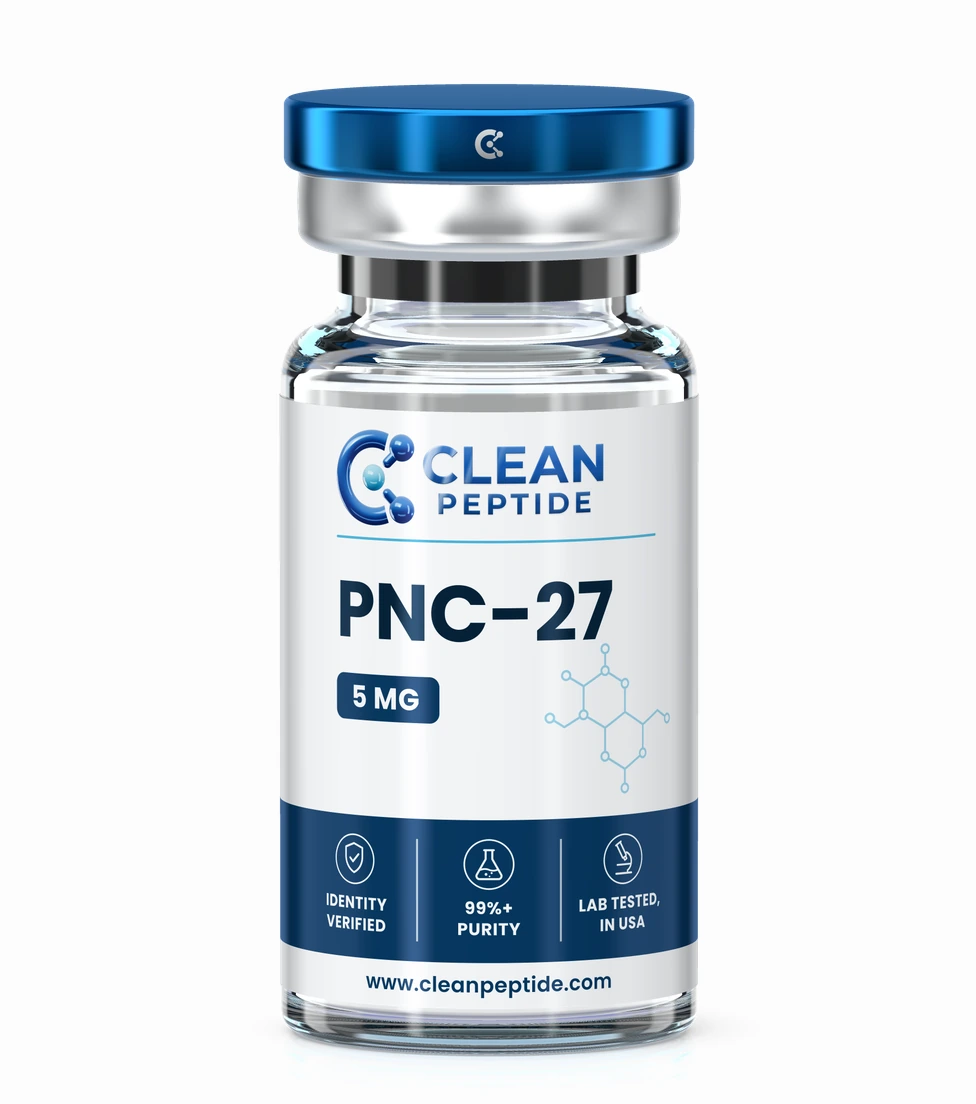
PNC-27 is a synthetic 32-residue chimeric peptide: residues 12–26 of the p53 protein, the stretch that binds HDM-2 (MDM2), joined to a 17-residue cationic leader the originating papers call the penetratin sequence. This PNC-27 peptide comes as 5 mg and 10 mg lyophilised vials, each size with its own ILS Laboratories certificate.
Order within 17h 12m · ships TueCutoff 3:00 PM ET (12:00 PM PT)
Arrives Thu, Oct 29 – Tue, Nov 3Free standard shipping on orders over $100
Free shipment protectionLost, stolen, or damaged? We replace it, on us.
Overnight and 2-day optionsPick your speed at checkout
We acceptSecure 256-bit checkoutVISAAMEX
Certificate of analysisPNC-27 · 5mg · BATCH ACE-2137485
Verified test results
Every batch, independently verified.
Each batch is analyzed by an ISO/IEC 17025 accredited third-party laboratory before it ships. This is the released report for the size selected above, exactly as the lab signed it.
Open any size’s signed certificate. Your order ships with the report for the size you buy.
PNC-27 5mg
Selected
LOT ACE-2137485
99.90%
HPLC purity · meets spec
Labeled
5mg
Measured
5.18mg
Identity
Confirmed
Heavy metals
Not Detected
Sterility
No Growth
Endotoxin
0.101 EU/mL
Tested
Sep 3, 2026
5 assays passed · ILS Laboratories, ISO/IEC 17025 accredited
PNC-27 10mg
Selected
LOT ACE-1756914
99.90%
HPLC purity · meets spec
Labeled
10mg
Measured
10.68mg
Identity
Confirmed
Heavy metals
Not Detected
Sterility
No Growth
Endotoxin
0.101 EU/mL
Tested
Sep 3, 2026
5 assays passed · ILS Laboratories, ISO/IEC 17025 accredited
What is PNC-27?
PNC-27 was designed by Matthew Pincus, Josef Michl and colleagues at SUNY Downstate in Brooklyn from conformational analysis of p53’s MDM-2-binding domain. Its first 15 residues, PPLSQETFSDLWKLL, are p53 residues 12–26; the last 17, KKWKMRRNQFWVKVQRG, are a positively charged leader that sits in cell membranes. That leader is often described as penetratin, the Antennapedia-derived cell-penetrating peptide, but it is not the canonical penetratin sequence: it is that sequence reversed, with two isoleucine-to-valine changes and an added glycine.
The group’s work proposes that PNC-27 binds HDM-2 sitting in the plasma membrane of cancer cells and forms pores there, so the cells studied died by necrosis rather than apoptosis, and that this happened whether or not the cells had working p53. In their experiments, untransformed cell lines without membrane HDM-2 were not affected. A shorter analogue, PNC-28, carries p53 residues 17–26 with the same leader and was used in most of the animal work. All of this is cell and animal research; there are no clinical trials.
PNC-28: p53 residues 17–26 + the same leader, 27 residues
This product
5 mg and 10 mg, lyophilised powder
Sources: Kanovsky M, et al., 2001, Rosal R, et al., 2004, UniProt and PubChem. PNC-27 has no FDA substance record and no CAS number confirmed by a registry; PubChem lists 1159861-00-3 only as a depositor synonym.
Certificates for the current lots
Each size is filled from its own lot and analysed separately by ILS Laboratories in San Diego, which states ISO/IEC 17025 accreditation for activities within its published scope. Both certificates are full QC panels: HPLC purity, net peptide content and identity by HPLC retention time, plus endotoxin, sterility, heavy metals and a fentanyl screen:
Transcribed from the certificate issued for each size on sale today. Open the signed certificate for any size under Verified test results above. Every PNC-27 COA, lot by lot
PNC-27 price
Price per vial and per milligram, read live from the store:
Size
List price
Price today
Per mg
Availability
5mg
$79.99
$55.99
$11.20
In stock
10mg
$149.99
$104.99
$10.50
In stock
Read from the store when this page loads, the same prices the PNC-27 product page shows.
Published research on PNC-27
About two dozen papers, most of them from the originating group, all in cell lines, patient-derived cells in culture, or rodents.
Necrosis, not apoptosis (2003). In breast cancer cell lines the p53(12-26) construct produced rapid non-apoptotic cell death. Do TN, et al. Oncogene, 2003.
Membrane HDM-2 as the target (2010). The p53 part of PNC-27 matched the HDM-2-bound p53 structure, the peptide co-localised with HDM-2 in cancer-cell membranes, and untransformed cells became susceptible once made to express membrane-anchored HDM-2. Sarafraz-Yazdi E, et al. PNAS, 2010.
The leader decides how cells die (2008). Using PNC-28, the p53 segment expressed alone gave apoptosis, while the same segment delivered as a peptide with the leader gave necrosis with membrane pores. Bowne WB, et al. Annals of Surgical Oncology, 2008.
Independent work in leukaemia cells (2020). A City of Hope and Zhejiang University group reported membrane HDM2 on human and mouse AML blasts but not on normal haematopoietic stem cells, and studied the peptide in cell and mouse models. Targeting cell membrane HDM2: A novel therapeutic approach for acute myeloid leukemia. Wang H, et al. Leukemia, 2020.
Imaging the pores (2022). Immuno-electron microscopy showed peptide and HDM-2 in roughly 1:1 ratios arranged in ring-like structures in cancer-cell membranes. Sarafraz-Yazdi E, et al. Biomedicines, 2022.
Several of the originating authors are named inventors on PNC-27 and PNC-28 patents, as their papers disclose. ClinicalTrials.gov lists no study of either peptide.
Regulatory status
PNC-27 is not an approved drug anywhere and is not in any FDA programme: it has no FDA application, no orphan designation, and has never been nominated for FDA’s compounding lists, so FDA has published no evaluation of it. Clean Peptide’s PNC-27 is a laboratory reference material only, not for human or veterinary use, and nothing on this page describes a treatment.
Related research
SS-31 and MOTS-c, other cell-biology research peptides with full ILS panels.
PNC-27 is a synthetic 32-residue peptide that joins p53 residues 12-26, the region that binds HDM-2 (MDM2), to a 17-residue cationic membrane leader. It was designed at SUNY Downstate in Brooklyn.
What is the PNC-27 sequence?+
PPLSQETFSDLWKLLKKWKMRRNQFWVKVQRG: PPLSQETFSDLWKLL from p53, then the leader KKWKMRRNQFWVKVQRG. PubChem computes C188H293N53O44S and about 4032 g/mol (CID 16201774).
What is the difference between PNC-27 and PNC-28?+
Both use the same leader. PNC-27 carries p53 residues 12-26 (32 residues in total); PNC-28 carries p53 residues 17-26 (27 residues). Most of the published animal work used PNC-28.
Has PNC-27 been tested in humans?+
No. ClinicalTrials.gov lists no study of PNC-27 or PNC-28, and all published work is in cell lines, patient-derived cells in culture, or rodents.
Is PNC-27 FDA-approved?+
No. It has no FDA application or orphan designation and has never been nominated for FDA’s compounding lists.
What do the PNC-27 certificates show?+
Each size has its own ILS Laboratories full QC panel, listed on this page with lot number, test date, HPLC purity, net peptide content and identity; the certificates also report endotoxin, sterility, heavy metals and a fentanyl screen.