A peptide COA should tell you far more than a polished “99% pure” headline. A useful report identifies the exact material and batch tested, the laboratory behind the work, the methods used, what each result establishes, and which checks are not documented.
To read it, match the compound and lot first, then review the lab, dates, HPLC purity, identity evidence, and any additional testing.
Research-use-only note: This guide covers laboratory documentation for research-use-only peptides, not human or veterinary use.
How to Read a Peptide COA in 60 Seconds
| Check | What to find | What it tells you |
|---|---|---|
| Compound | Exact name and variant |
What sample was submitted |
| Lot | Number matching the vial |
Which peptide batch was tested |
| Laboratory | Lab and report number |
Who performed the work |
| Dates | Analysis or report date |
When testing occurred |
| HPLC | Purity percentage and chromatogram |
Relative chromatographic purity |
| Mass spec | Expected and observed mass |
Whether mass supports identity |
| Other tests | Separate named results |
What else was actually checked |
What Is a Peptide Certificate of Analysis?
A peptide Certificate of Analysis is the laboratory record for one tested sample or batch. It should let you connect the results to a named compound, see when and where the analysis took place, and identify the method used for each test.
FDA lists details such as the batch number, tests performed, acceptance limits, numerical results, and laboratory information as important COA fields [1]. If a test is missing, the certificate provides no evidence that it was performed.
Step 1: Check the Peptide Name and Batch Number
The name identifies the sample. The batch number connects it to the material in hand.
Does the Compound Match the Product?
Match the name, variant, labeled fill, and chemical form. A salt, blend, or modified sequence is not automatically the same chemical compound as the target peptide.
Does the Lot Number Match?
The lot on the vial should match the batch-specific COA:
product → lot → laboratory report
One certificate reused for unrelated lots cannot verify the current batch.
Step 2: Verify the Testing Laboratory and Report Dates
A legitimate COA should reveal who tested the sample and when. The format may vary, but traceability should not.
Who Issued the COA?
Look for the lab name, contact details, report number, and any authorization or accreditation statement. Accreditation matters only when its scope covers the method.
When Was the Sample Tested?
Check the received, analysis, report, or completion date. Layouts vary, so no single field is universal. The goal is to date that specific sample’s testing.
Can the Report Be Independently Verified?
Use the laboratory’s QR code, COA lookup, or verification page when available. Third-party peptide verification is stronger when the third-party lab can confirm the report directly.
Step 3: Read the HPLC Purity Result
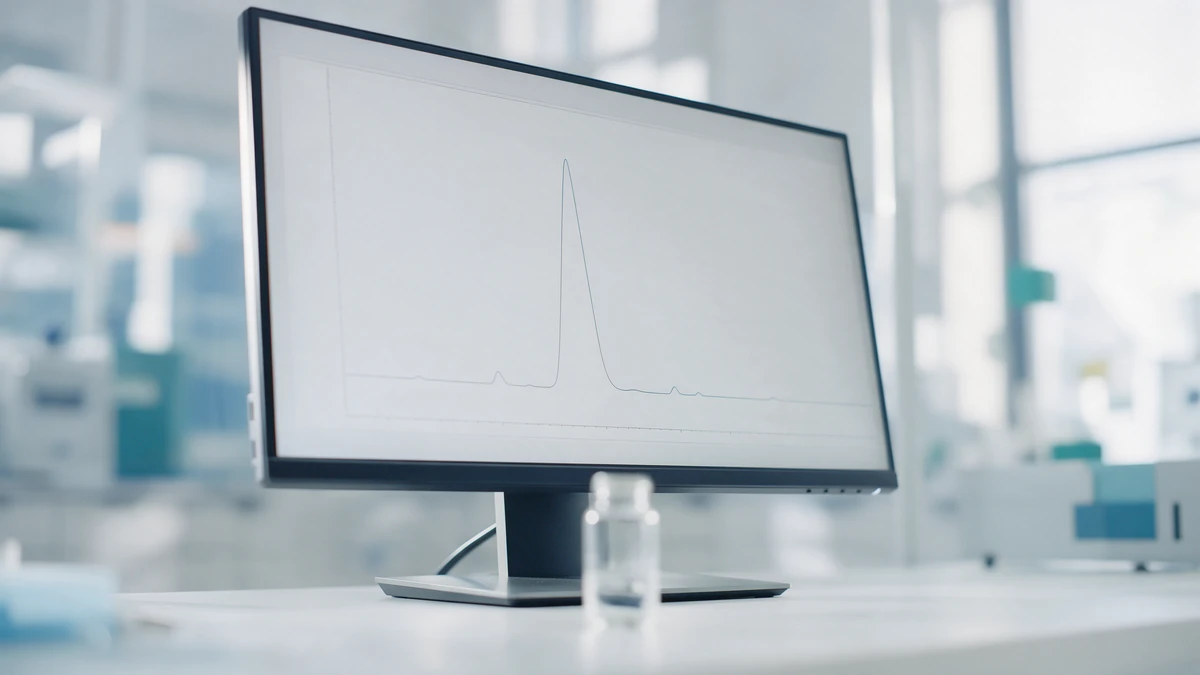
High-performance liquid chromatography separates detectable components moving through a column. Its chromatogram displays peaks whose integrated areas support peptide purity analysis.
What Does 99% HPLC Purity Mean?
A 99% result usually means the main peak produced about 99% of the integrated chromatographic area under that method.
It does not mean 99% of the powder’s weight is actual peptide. It also does not prove identity, sterility, endotoxin status, or heavy-metal results.
What Should You Look for on the Chromatogram?
Find the main peak, smaller related impurities, area percentage, retention information, and method. Raw analytical data gives more context than one number. Other compounds or degradation products can interfere, so selectivity matters [2].
Step 4: Check Mass Spectrometry for Peptide Identity
These tests answer different questions, and neither replaces the other:
- HPLC: How chromatographically pure is the sample?
- Mass spectrometry: Is the measured molecular mass consistent with the expected compound?
Expected vs. Observed Molecular Mass
A mass-spec section may show the expected molecular weight, observed mass, and a spectrum of charged ions. The actual peptide mass should fit the expected molecule within the lab’s tolerance.

Strong molecular identity verification often uses a second analytical principle [2][3]. That is the point of careful peptide verification: no single number can verify peptide quality.
Step 5: Understand Purity vs. Peptide Content
High purity does not state how much material is in the vial. Quantity needs its own result.
HPLC Purity
It describes the sample’s relative chromatographic composition. It does not report the vial’s total amount.
Net Peptide Content, Assay, or Measured Fill
Peptide content addresses quantity. Depending on the method, net peptide content may account for water, counterions, or residual material in lyophilized peptides.
Step 6: Check What Else Was, and Wasn’t, Tested
Purity and identity cover only part of the sample. Next, check whether the COA includes separate results for:
- Endotoxin: Look for the test method, unit, numerical result, and reporting limit. Endotoxin testing checks for bacterial toxins. It does not prove sterility.
- Sterility or bioburden: Sterility testing looks for viable microorganisms, while bioburden testing measures the number of microbes present.
- Heavy metals: Check which metals were included, the method used, and the limit for each one. “Not detected” means the amount fell below that method’s detection or reporting limit. It does not mean the sample contains absolutely none.
- Residual solvents: These tests look for solvents that may remain after synthesis or purification. The COA should name the solvents included and report the result for each one.
- Water content: Moisture can add to the powder’s total weight and affect peptide content calculations.
- Net peptide content: This result addresses how much peptide material is present in the vial. It is separate from HPLC purity, which compares the relative size of detected chromatographic peaks.

How to Spot a Weak or Questionable Peptide COA
- No lot number, or one that does not match the vial
- No named laboratory or traceable report number
- A purity claim without an HPLC report
- Identity and purity presented as the same result
- One old certificate attached to several unrelated batches
- A cropped or edited document
- Product-page claims that exceed the COA testing shown
Worked Example: How to Read a Real Peptide COA
Here is what a useful COA looks like in practice. This is the COA for our IGF-1 LR3 1 mg research material from lot ACE-1279625. It shows who tested the batch, when the analysis took place, which methods were used, and the exact result from each test.
- Testing laboratory: ILS Laboratories in San Diego, California, performed the analysis. The report includes the lab’s contact details and a QR code for independent verification.
- Material tested: The sample is identified as IGF-1 LR3 with a labeled content of 1 mg. Its matrix is listed as lyophilized, which means the material was tested in freeze-dried form.
- Lot number: The report is tied to lot ACE-1279625. This number connects the laboratory results to the matching batch of our IGF-1 LR3 research material.
- Testing dates: ILS Laboratories received the sample on August 27, 2026, and analyzed it on September 9, 2026. These dates show when this specific lot entered and completed testing.
- Purity and content: HPLC measured 99.90% purity against a minimum specification of 95.0%. Net peptide content was reported separately at 1.03 mg, showing that purity and the amount in the vial were measured as different results.
- Identity: The report lists IGF-1 LR3 identity as confirmed through HPLC retention-time matching, or HPLC-RTM.
- Additional analyses: Five heavy metals were not detected by ICP-MS. Fentanyl was not detected at a 50 ng/mL cutoff, the PCR row reported “No Growth,” and endotoxin measured 0.101 EU/mL against the report’s stated level of less than 0.25 EU/mL.
At CleanPeptide, we publish this batch-level documentation for every product on its product page, so you can see more than a headline percentage. You can check the material, lot, laboratory, method, limits, and individual results before deciding whether the batch fits your research.
What a Good Peptide Supplier Should Make Easy to Verify
You should not have to search through a website or contact support just to find the evidence behind a peptide. Before ordering from a reliable peptide supplier, you should be able to identify the current batch, open its matching COA, see which laboratory completed the work, and review every method and result.
At CleanPeptide, we publish batch-specific certificates directly with our research materials. This lets you review the documentation first and confirm exactly what was tested before choosing a product for your research.
See the testing behind the batch before you order.
Browse Research Peptides and View Batch COAs →
Peptide COA Checklist Before You Buy
☐ Correct compound
☐ Matching lot or batch
☐ Named testing laboratory
☐ Relevant testing dates
☐ HPLC purity analysis
☐ Identity verification method
☐ Additional tests clearly named
If an item is missing, investigate before relying on that specific COA. A COA is also not a peptide storage guide, so follow the separate storage information for the product.
FAQ
What Does COA Mean for Peptides?
COA means Certificate of Analysis. It records the tests and results for a named sample or peptide batch. It is evidence for the listed analyses, not every aspect of peptide quality.
How Do You Know if a Peptide COA Is Real?
Match the compound and lot, identify the lab, and check the dates, methods, and report number. Use third-party verification or the laboratory’s COA lookup when available.
What Does 99% Purity Mean on a Peptide COA?
It usually means the main HPLC peak represents about 99% of the integrated chromatographic area under that method. It does not mean the vial contains 99% peptide by weight.
Is HPLC Purity the Same as Peptide Content?
No. HPLC purity compares detected peaks. Peptide content measures the amount of peptide material present, using a suitable quantitative method.
Does HPLC Confirm Peptide Identity?
Not fully by itself. Retention-time matching can support identity, but mass spectrometry or another complementary method provides different evidence about molecular identity [3].
What Does Mass Spectrometry Show on a Peptide COA?
It compares the observed mass-to-charge pattern with the expected peptide mass. A matching result supports molecular identity, subject to the method and interpretation.
Should Every Peptide Batch Have Its Own COA?
Ideally, yes. A lot-specific report connects the tested sample to the material supplied. Results from an older batch do not verify a later one [1].
Does a Peptide COA Prove Sterility?
Only when a named sterility method and result are shown. HPLC, mass spec, endotoxin testing, and microbial testing are separate analyses.
What Information Should a Peptide Certificate of Analysis Include?
Look for the peptide, lot, laboratory, dates, methods, specifications, and results. Chromatograms, spectra, content, and contaminant tests should appear only when performed.
Where Can I Find Third-Party-Tested Research Peptides With Batch-Specific COAs?
Choose suppliers that publish the full report before purchase and connect it to the current lot. We make our batch COAs available from the relevant CleanPeptide product pages.
Research Sources
- Q7A Good Manufacturing Practice Guidance for Active Pharmaceutical Ingredients
FDA guidance on batch records, laboratory controls, traceability, and COA contents for pharmaceutical ingredients. - Q2(R2) Validation of Analytical Procedures
FDA and ICH guidance on analytical method selectivity, accuracy, precision, range, detection limits, and validation. - Q6A Specifications: Test Procedures and Acceptance Criteria
FDA and ICH guidance on identity, assay, impurities, specifications, and complementary analytical methods. - Liquid Chromatography-High Resolution Mass Spectrometry for Peptide Drug Quality Control
An LC-HRMS study of identity and low-level impurities in salmon calcitonin, bivalirudin, and exenatide. - Survey of Peptide Quantification Methods and Their Reproducibility Comparison: A Case Study Using Oxytocin
A multi-laboratory comparison of HPLC assay, quantitative NMR, and amino acid analysis for oxytocin. - Pyrogen and Endotoxins Testing: Questions and Answers
FDA guidance on bacterial endotoxin methods, limits, interference, sampling, and result interpretation. - Pharmaceutical Microbiology Manual
FDA laboratory procedures for sterility, microbial enumeration, specified microorganisms, and bacterial endotoxin testing. - Q3D(R2) Elemental Impurities
FDA and ICH guidance on risk assessment and control of arsenic, cadmium, mercury, lead, and other elemental impurities.