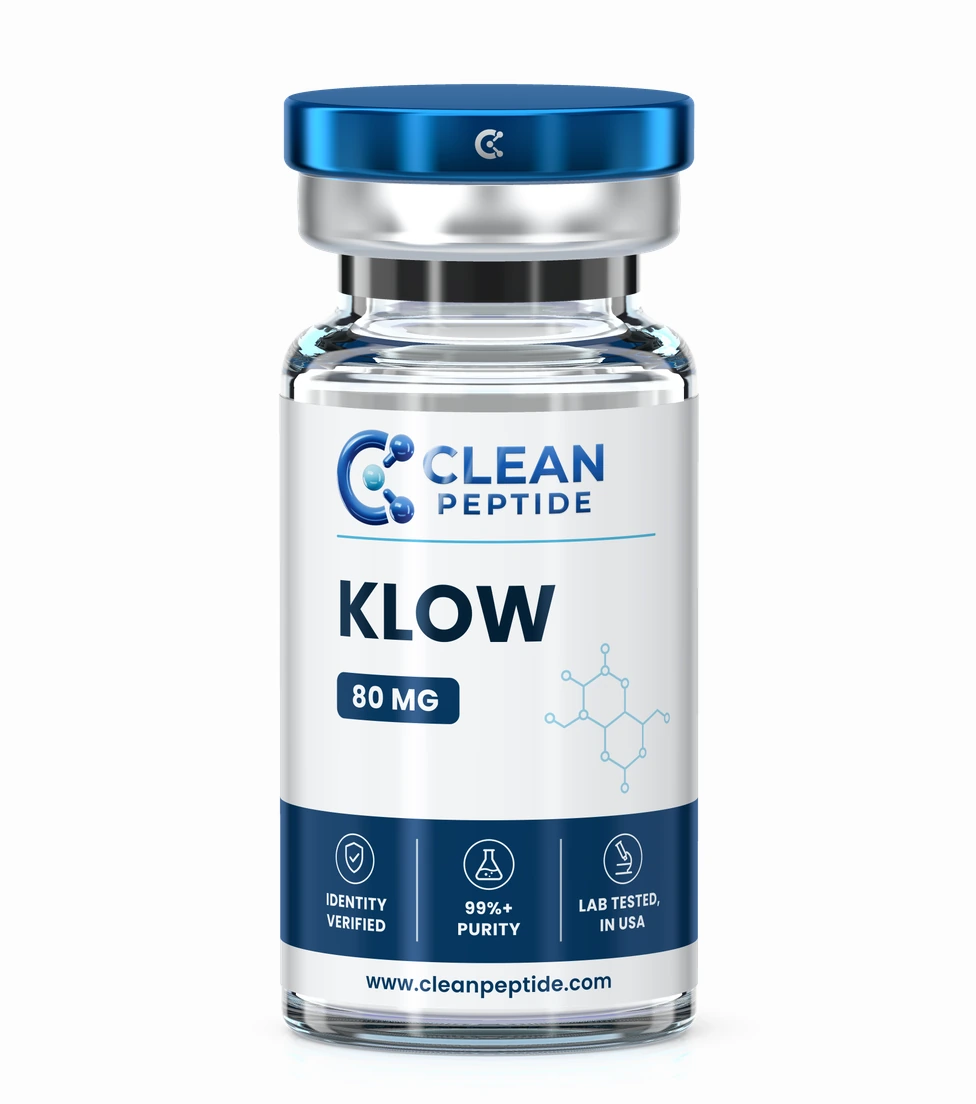


KLOW 80mg KPV, BPC-157, TB-500 and GHK-Cu
KLOW is a four-peptide research blend: GHK-Cu, KPV, TB-500 and BPC-157 in one 80 mg lyophilised vial. The certificate for each lot measures all four peptides separately, as well as the HPLC purity of the blend.
Original price was: $152.93.$107.05Current price is: $107.05.
−30% applied
- Order within 17h 12m · ships TueCutoff 3:00 PM ET (12:00 PM PT)
- Arrives Thu, Oct 29 – Tue, Nov 3Free standard shipping on orders over $100
- Free shipment protectionLost, stolen, or damaged? We replace it, on us.
- Overnight and 2-day optionsPick your speed at checkout
- We acceptSecure 256-bit checkout
Verified test results
Every batch, independently verified.
Each batch is analyzed by an independent third-party laboratory before it ships. This is the released report for the size selected above, exactly as the lab issued it.
Certificate of analysis
99.97%
Purity by HPLC
- Tested
- Sep 17, 2026
What is the KLOW peptide blend?
“KLOW” is a market name, not a scientific one. It describes a vial that combines the three peptides sold together as “GLOW” (GHK-Cu, BPC-157 and TB-500) with a fourth, KPV. The K is for KPV. Clean Peptide’s KLOW is labelled 80 mg in total, and the composition below is what the laboratory measured in this lot, not a formula we are asking you to take on trust.
No published study has tested these four peptides together, and none has tested GLOW either. What exists is research on each component separately, summarised below with links to its own product page, and the certificate showing what is actually in this vial. If you are comparing the two blends, see KLOW vs GLOW; for GLOW on its own, see the GLOW peptide blend.
What is in KLOW: composition by certificate
| Component | What it is | Sequence | Measured in this lot |
|---|---|---|---|
| GHK-Cu | Copper(II) complex of the tripeptide Gly-His-Lys |
GHK · Cu2+ |
54.90 mg (listed on the certificate as GHK) |
| KPV | Alpha-MSH(11-13) tripeptide |
KPV |
11.90 mg |
| TB-500 | N-acetylated thymosin beta-4 fragment 17-23 |
Ac-LKKTETQ |
11.07 mg |
| BPC-157 | 15-residue gastric peptide fragment |
GEPPPGKPADDAGLV |
10.92 mg |
| Total | 88.79 mg (label 80 mg) |
Amounts from certificate CLP#00006 (HYTE Research Division, analysed 17 September 2026), quantity by curve assay against a specification of not less than 90% of label claim; all four passed.
Certificate for the current lot
| Laboratory | Analysed | HPLC purity | Measured content |
|---|---|---|---|
| HYTE Research Division | 17 Sep 2026 | 99.97% | 88.79mg |
Transcribed from the certificate issued for each size on sale today. Open the signed certificate for any size under Verified test results above.
The same certificate confirms the identity of all four peptides by HPLC-DAD and reports endotoxin below 0.5 EU/mL, no growth on sterility testing and heavy metals not detected. It does not print a lot number; the report number is CLP#00006.
Published research on the KLOW components
Each component has its own literature, almost all of it in cells and animals. Combining them in one vial has not been studied, so nothing below describes the blend.
- GHK-Cu. Stimulated collagen synthesis in cultured fibroblasts from picomolar concentrations and increased collagen and glycosaminoglycans in a rat wound-chamber model. Maquart FX, et al. FEBS Letters, 1988; Maquart FX, et al. Journal of Clinical Investigation, 1993.
- KPV. Entered intestinal cells through PepT1, inhibited NF-κB signalling and reduced colitis in mice; its effect does not appear to run through melanocortin receptors. Dalmasso G, et al. Gastroenterology, 2008; Getting SJ, et al. JPET, 2003.
- TB-500. Identified analytically as Ac-LKKTETQ, the acetylated actin-binding fragment of thymosin beta-4. In a 2024 study only one of its metabolites, Ac-LKKTE, showed wound-healing activity in a fibroblast assay. Esposito S, et al. Drug Testing and Analysis, 2012; Rahaman KA, et al. Journal of Chromatography B, 2024.
- BPC-157. Improved healing measures of transected rat Achilles tendon and promoted tendon-fibroblast migration through FAK–paxillin signalling. Staresinic M, et al. Journal of Orthopaedic Research, 2003; Chang CH, et al. Journal of Applied Physiology, 2011.
Regulatory status
No blend of these peptides is an approved product. Of the components, BPC-157, TB-500 and KPV were placed in FDA’s compounding safety-risk category in 2023 and are now listed there as nominated-but-withdrawn; injectable GHK-Cu followed the same path. WADA’s 2026 Prohibited List names BPC-157 and TB-500. FDA compounding safety-risk list. Clean Peptide’s KLOW is a laboratory reference material only.
Related research
- KLOW vs GLOW: what the K adds.
- What is the GLOW peptide blend?
- BPC-157 / TB-500 blend and the “Wolverine stack” explained.
- Peptide blends vs single peptides.
What is on file, and how it is handled
Every figure below is transcribed from the paperwork for this compound.
Material
- Compound
- KLOW 80mg (KPV, BPC-157, TB-500 and GHK-Cu)
- Class
- Four-peptide research blend
- Form
- Lyophilised powder
- Sequence
- GHK·Cu + KPV + Ac-LKKTETQ (TB-500) + GEPPPGKPADDAGLV (BPC-157)
- Residues
- 4 peptides
Verification
- Identity
- Confirmed on the certificate of analysis
- Purity
- ≥ 99.97% by HPLCSee certificate
- Batch
- See certificate
- Documentation
- Per-batch certificate of analysis
Handling
- Storage
- Store at −20 °C, protected from light
- Intended use
- In-vitro laboratory research only
QuestionsKLOW 80mg: frequently asked
What is KLOW peptide?+
KLOW is a research blend of four peptides in one vial: GHK-Cu, KPV, TB-500 and BPC-157. The name is a market name; it is GLOW (GHK-Cu, BPC-157, TB-500) plus KPV.
What is in Clean Peptide's KLOW?+
The current certificate (CLP#00006) measured GHK 54.90 mg, KPV 11.90 mg, TB-500 11.07 mg and BPC-157 10.92 mg: 88.79 mg in total against an 80 mg label, at 99.97% HPLC purity.
What is the difference between KLOW and GLOW?+
KLOW contains KPV; GLOW does not. Otherwise both are blends of GHK-Cu, BPC-157 and TB-500, and ratios vary between sellers.
Has the KLOW blend been studied?+
No. No published study has tested these four peptides together, or GLOW’s three. The research that exists is on each peptide separately.
Who tested this KLOW lot?+
HYTE Research Division, on 17 September 2026. The certificate confirms all four peptides by HPLC-DAD and measures each one’s quantity.
Does Clean Peptide sell the KLOW components separately?+
Yes: GHK-Cu, KPV, TB-500 and BPC-157 are each sold as single peptides, and BPC-157 with TB-500 as a two-peptide blend.
Related products
-
Research use only−30%
 Healing Research Peptides
BPC-157 / TB-500 Blend
Original price was: $77.99.$54.59Current price is: $54.59.Learn more about BPC-157 / TB-500 Blend -
Research use only−30%
 Longevity & Mitochondrial Peptides
MOTS-C
Original price was: $72.00.$50.40Current price is: $50.40.Learn more about MOTS-C -
Research use only−30%
 Healing Research Peptides
KPV
Original price was: $52.89.$37.02Current price is: $37.02.Learn more about KPV -
Research use only−30%
 Growth Hormone & IGF Peptides
CJC-1295
Original price was: $99.99.$69.99Current price is: $69.99.Learn more about CJC-1295