Melanotan I vs Melanotan II: What’s the Difference?
Melanotan I and Melanotan II are both synthetic analogues of alpha-melanocyte-stimulating hormone (α-MSH), designed at the University of Arizona, and both carry the same two substitutions, norleucine at position 4 and D-phenylalanine at position 7. They differ in length, shape, receptor selectivity and regulatory fate.
Melanotan I (afamelanotide, [Nle4, D-Phe7]-α-MSH) keeps all 13 residues of α-MSH in a linear chain and binds mainly the MC1 receptor. It is the active ingredient of Scenesse, approved by FDA in 2019 and in the EU in 2014 for erythropoietic protoporphyria.
Melanotan II is a cyclic 7-residue fragment with a lactam bridge, a potent but nonselective agonist at MC1, MC3, MC4 and MC5 receptors. It is not approved anywhere, and regulators including the UK MHRA have warned against unlicensed products.
In short: the same starting hormone and the same two key substitutions, cut and shaped differently, with opposite regulatory outcomes.
Melanotan I vs Melanotan II at a Glance
Melanotan I is a linear 13-residue peptide (C78H111N21O19, 1,646.8 g/mol); Melanotan II is a cyclic 7-residue peptide (C50H69N15O9, 1,024.2 g/mol). Both are N-acetylated, C-amidated and share the His-D-Phe-Arg-Trp core. Melanotan I is an approved drug as afamelanotide; Melanotan II is not.
| Comparison | Melanotan I | Melanotan II |
|---|---|---|
| Peptide length | 13 amino acids | 7 amino acids (cyclic) |
| Molecular weight | 1,646.8 g/mol | 1,024.2 g/mol |
| Sequence | Ac-SYS-Nle-EH-(D-Phe)-RWGKPV-NH2 | Ac-Nle-cyclo[Asp-His-(D-Phe)-Arg-Trp-Lys]-NH2 |
| Molecular relationship | Linear [Nle4, D-Phe7]-α-MSH | Cyclic lactam α-MSH(4-10) analogue |
| Main research focus | MC1 receptor; photodermatosis research | MC1, MC3, MC4 and MC5 receptors |
| Research evidence | Phase 3 trials; FDA- and EU-approved | Receptor pharmacology; small early human studies |
| FDA-approved drug component | Yes (Scenesse, 2019) | No |
What are Melanotan I and Melanotan II
13 AA
Melanotan I
The full 13-residue α-MSH sequence with norleucine at 4 and D-phenylalanine at 7, first reported in 1980 as an enzyme-resistant, long-acting analogue.
Research areas
MC1R • Melanin density measurements • Erythropoietic protoporphyria • Photodermatoses
In radioligand binding it had its highest affinity at MC1 (Kd 85 pM), lower at MC3, MC4 and MC5, and none at the ACTH receptor MC2. The FDA label describes it as binding predominantly to MC1R.
7 AA
Melanotan II
A seven-residue α-MSH fragment cyclised by a lactam bridge between Asp5 and Lys10, with the same Nle and D-Phe substitutions as Melanotan I.
Research areas
Melanocortin receptor pharmacology • MC4R • Structure-activity studies
Primary pharmacology papers describe it as a potent, nonselective melanocortin agonist. Bremelanotide (PT-141), its free-acid analogue, is a separate molecule that FDA approved in 2019 as Vyleesi; that approval does not extend to Melanotan II.
Explore Melanotan IIα-MSH: 13 AANle4 + D-Phe7 in bothMT-I: 13 AA linear · MT-II: 7 AA cyclic
MT-II keeps residues 4-10 and closes them into a ring
Key Differences Between Melanotan I and Melanotan II
| Key differences | Melanotan I | Melanotan II |
|---|---|---|
| Shape | Linear chain, all 13 residues of α-MSH. |
Cyclic: residues 4-10, with Glu5→Asp and Gly10→Lys joined by a lactam bridge. |
| Receptor selectivity | Highest affinity at MC1; lower at MC3, MC4, MC5; none at MC2. |
Potent and nonselective across MC1, MC3, MC4 and MC5. |
| Approved products | Afamelanotide: Scenesse implant, FDA 8 Oct 2019 and EU 22 Dec 2014, for erythropoietic protoporphyria. |
None. Its free-acid relative bremelanotide (Vyleesi) is a different, approved molecule. |
| Clinical path | Skin-pigmentation studies, then phase 3 trials in erythropoietic protoporphyria and studies in other photodermatoses. |
Early University of Arizona studies took a different direction; it was never developed to approval. |
| Regulator warnings | The approved implant carries label warnings (hypersensitivity; skin checks for darkening moles). |
The UK MHRA warned the public against unlicensed "Melanotan" products in 2008 and 2013; FDA issued a warning letter to a seller in 2007. |
| FDA compounding | Not on FDA's compounding risk lists as afamelanotide. |
Listed by FDA among bulk substances nominated, then withdrawn, from its compounding safety-risk category. |
How their research profiles differ
- Melanotan I
- 13-AA linear α-MSH analogue
- MC1-preferring
- Approved drug (afamelanotide)
- Melanotan II
- 7-AA cyclic α-MSH analogue
- Nonselective MC1/3/4/5
- Research compound, not approved
Melanotan I vs Melanotan II: Which Is Better?
They answer different research questions. Melanotan I is the more selective tool for MC1 receptor work and the one with an approval file and phase 3 data behind it. Melanotan II is the broader, more potent tool across four melanocortin receptors, which is why it is used in receptor pharmacology and structure-activity work.
No trial has compared the two head to head.
Does the model need MC1-preferring activity, or activity across MC1, MC3, MC4 and MC5?
Can Melanotan I and Melanotan II Be Studied Together?
They are commonly compared side by side in receptor-binding studies, where the difference between a linear MC1-preferring agonist and a cyclic nonselective one is the point of the experiment.
Giving both in one condition would overlap at MC1, so their individual contributions could not be separated.
There Isn’t One Universal “Winner”
Melanotan I
Linear, MC1-preferring
13 AA • afamelanotide • approved
Melanotan II
Cyclic, nonselective
7 AA • not approved
Compare the Research. Verify the Material.
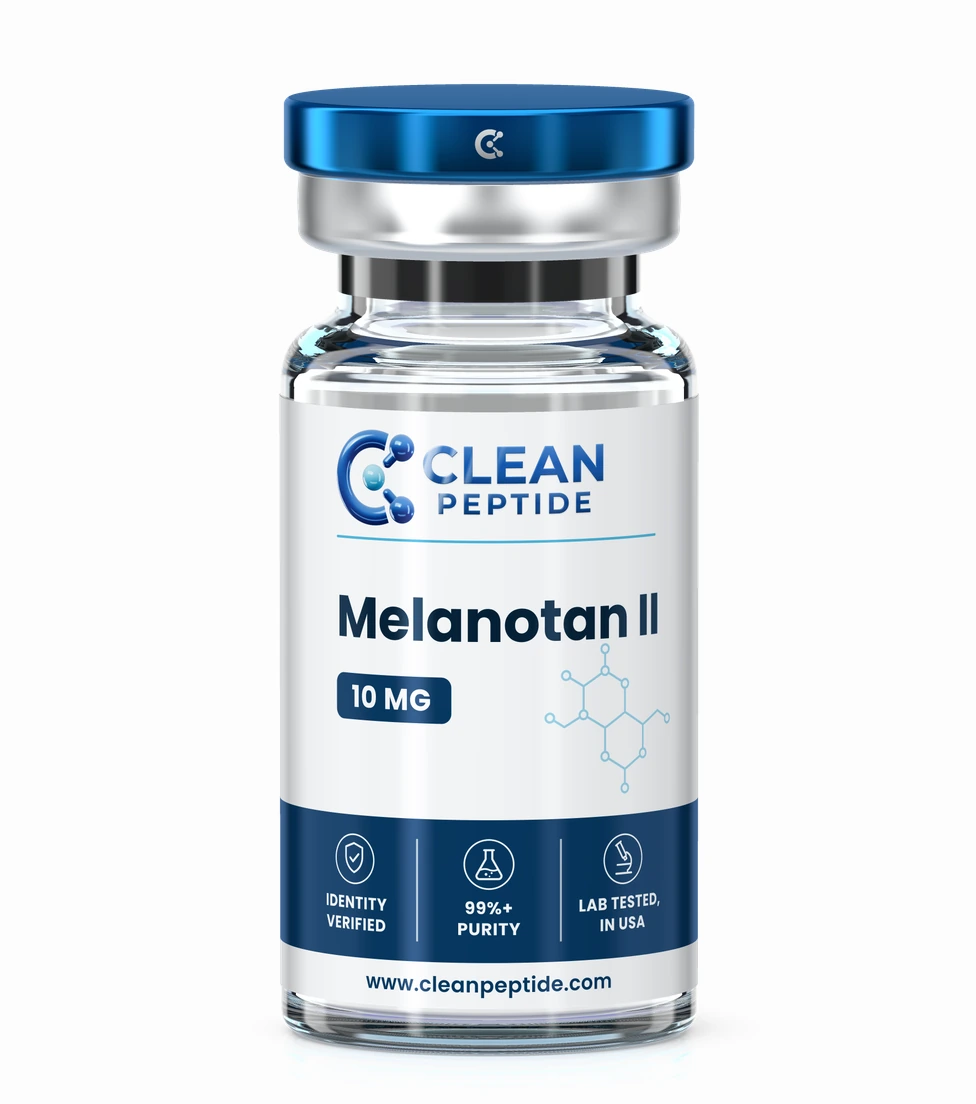
Clean Peptide stocks Melanotan II as a 10 mg lyophilised vial, with its lot certificate (HPLC purity, measured content and identity) on the product page.
We do not stock Melanotan I. Afamelanotide's only approved form is Clinuvel's Scenesse implant.
 Research use only
 Identity
verified Purity
verified
Question
Frequently Asked
What is the difference between Melanotan 1 and Melanotan 2?
Melanotan I is a linear 13-residue α-MSH analogue that binds mainly the MC1 receptor; Melanotan II is a cyclic 7-residue analogue that binds MC1, MC3, MC4 and MC5 without much selectivity. Melanotan I is approved as afamelanotide; Melanotan II is not approved anywhere.
Is Melanotan 1 the same as afamelanotide?
Yes. Afamelanotide is the international name for [Nle4, D-Phe7]-α-MSH, the molecule first called Melanotan I. The approved medicine is specifically Clinuvel's Scenesse implant.
Is Melanotan 2 FDA-approved?
No. FDA has approved bremelanotide (Vyleesi), a closely related but distinct molecule, and afamelanotide (Scenesse), but not Melanotan II. FDA lists Melanotan II among substances withdrawn from its compounding nominations.
Why is Melanotan 2 cyclic?
Its seven residues are closed into a ring by a lactam bond between aspartate 5 and lysine 10. The ring constrains the peptide's shape; primary pharmacology papers describe the resulting molecule as superpotent but nonselective.
What are their molecular weights?
Melanotan I is 1,646.8 g/mol (C78H111N21O19, CAS 75921-69-6). Melanotan II is 1,024.2 g/mol (C50H69N15O9, CAS 121062-08-6).
Have regulators warned about Melanotan?
Yes. The UK MHRA warned the public against unlicensed Melanotan I and II products in 2008 and again in 2013, and FDA sent a warning letter to a Melanotan II seller in 2007.
Research Peptides. Documented by Batch.
Every size in the catalogue ships against the certificate issued for its own lot.
For laboratory research use only. Not for human or veterinary use.
References
Identity data come from the FDA label for Scenesse, the FDA substance registry (GSRS) and PubChem. Regulatory facts come from Drugs@FDA, EMA, FDA's compounding pages and MHRA releases.
- Sawyer TK, et al. 4-Norleucine, 7-D-phenylalanine-alpha-melanocyte-stimulating hormone: a highly potent alpha-melanotropin with ultralong biological activity PNAS, 1980. The original Melanotan I paper.
- Schiöth HB, et al. Characterisation of melanocortin receptor subtypes by radioligand binding analysis European Journal of Pharmacology, 1995. MT-I receptor affinities.
- Hruby VJ, et al. Cyclic lactam alpha-melanotropin analogues of Ac-Nle4-cyclo[Asp5, D-Phe7,Lys10] alpha-melanocyte-stimulating hormone-(4-10)-NH2 with bulky aromatic amino acids at position 7 show high antagonist potency and selectivity at specific melanocortin receptors Journal of Medicinal Chemistry, 1995. The MT-II scaffold.
- Doedens L, et al. Multiple N-methylation of MT-II backbone amide bonds leads to melanocortin receptor subtype hMC1R selectivity: pharmacological and conformational studies Journal of the American Chemical Society, 2010. MT-II as superpotent but nonselective.
- Langendonk JG, et al. Afamelanotide for Erythropoietic Protoporphyria NEJM, 2015. The phase 3 trials.
- Hadley ME, Dorr RT. Melanocortin peptide therapeutics: historical milestones, clinical studies and commercialization Peptides, 2006. The Arizona history of MT-I and MT-II.
- Habbema L, et al. Risks of unregulated use of alpha-melanocyte-stimulating hormone analogues: a review International Journal of Dermatology, 2017.
- FDA label Scenesse (afamelanotide) implant Structure, receptor, indication and warnings.